
Confluence for 6.28.26
We'll all be using coding tools soon enough. Why AI tells matter. Watch and learn. The shifting value of human expertise.

Welcome to Confluence. Here’s what has our attention this week at the intersection of generative AI, leadership, and corporate communication:
We’ll All Be Using Coding Tools Soon Enough
Why AI Tells Matter
Watch and Learn
The Shifting Value of Human Expertise
We’ll All Be Using Coding Tools Soon Enough
The leading labs forecast how the rest of us will soon use AI.
OpenAI published an interesting paper earlier this week on the patterns of AI tool usage, contrasting the amount and nature of more agentic AI use across three populations: OpenAI employees, non-OpenAI personal-account holders, and non-OpenAI organizational-account holders. In this case, “agentic” means the use of OpenAI’s agentic coding platform, Codex (their equivalent to Anthropic’s Claude Code). You may read the paper here, and OpenAI’s blog post on the paper here. There are several conclusions worth noting (all quoted here from the abstract):
We find that agentic AI usage is growing rapidly: the number of active users has grown more than fivefold in the first half of 2026, with the most rapid increase occurring outside the initial audience of software developers.
Uptake is uneven across contexts: within OpenAI, Codex usage is nearly universal and has largely replaced business usage of ChatGPT. We document a similar shift to agentic tooling outside OpenAI, particularly within organizations, although external adoption remains lower and more uneven.
[a] growing number of users have used Codex to change their workflows substantially. We find that more than 10% of users manage three or more concurrent Codex agents at some point each week and that 26.6% use skills, which allow users to share instructions for complex workflows.
[r]equest complexity has increased: since the start of the year, the share of individual Codex users who submit at least one request for a task estimated to require more than eight hours for an experienced human to complete has increased nearly tenfold.
Concurrently, output has grown rapidly—in June 2026, the median OpenAI employee in a legal role generated 13 times more monthly output tokens across Codex and ChatGPT than they did in November 2025, while the median researcher generated more than 50 times as many.
So, the gist: Agentic use is growing rapidly, it’s changing workflows in real ways, with users using Codex for more complex tasks that meaningfully increase output. But for us, the most meaningful finding is the comparison across the three populations (OpenAI employees, personal-account holders, and organizational-account holders). These graphs show differences in how these groups are using AI (all courtesy OpenAI):
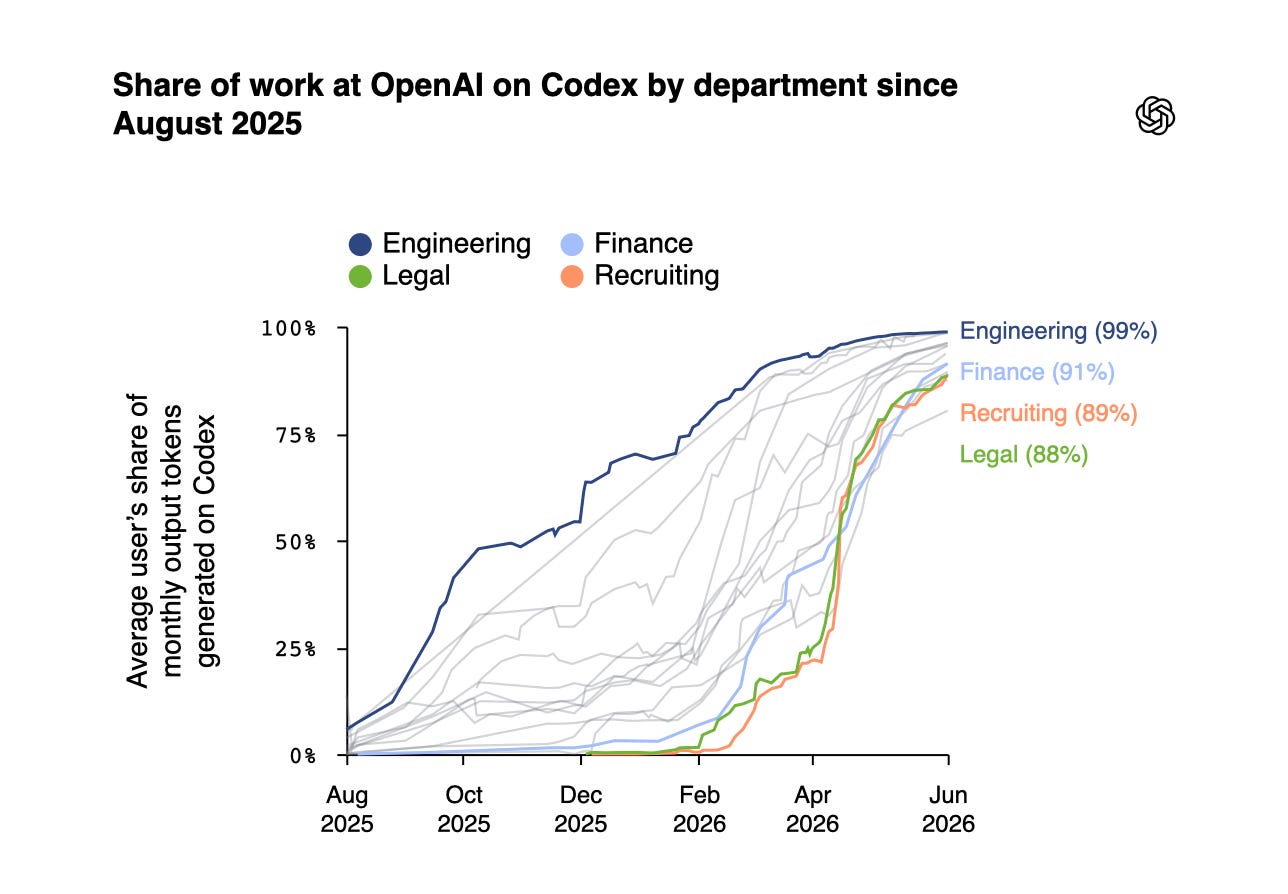
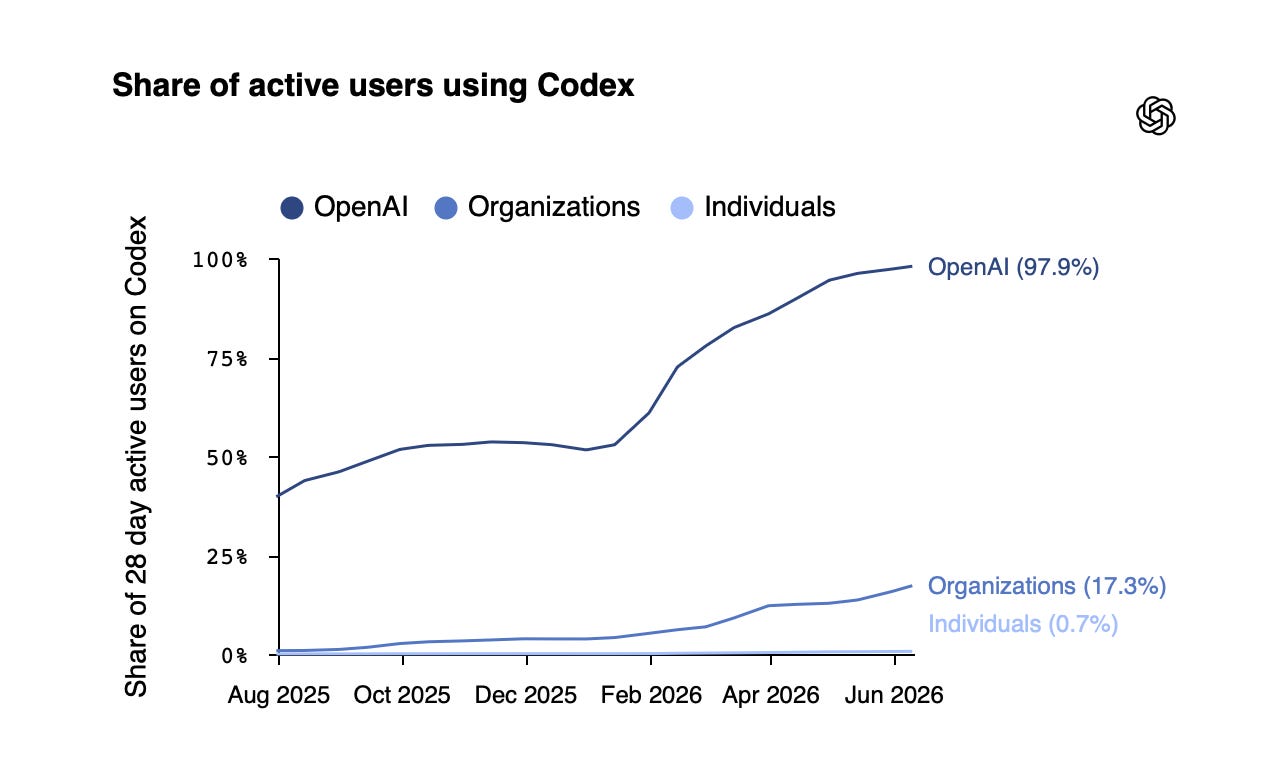
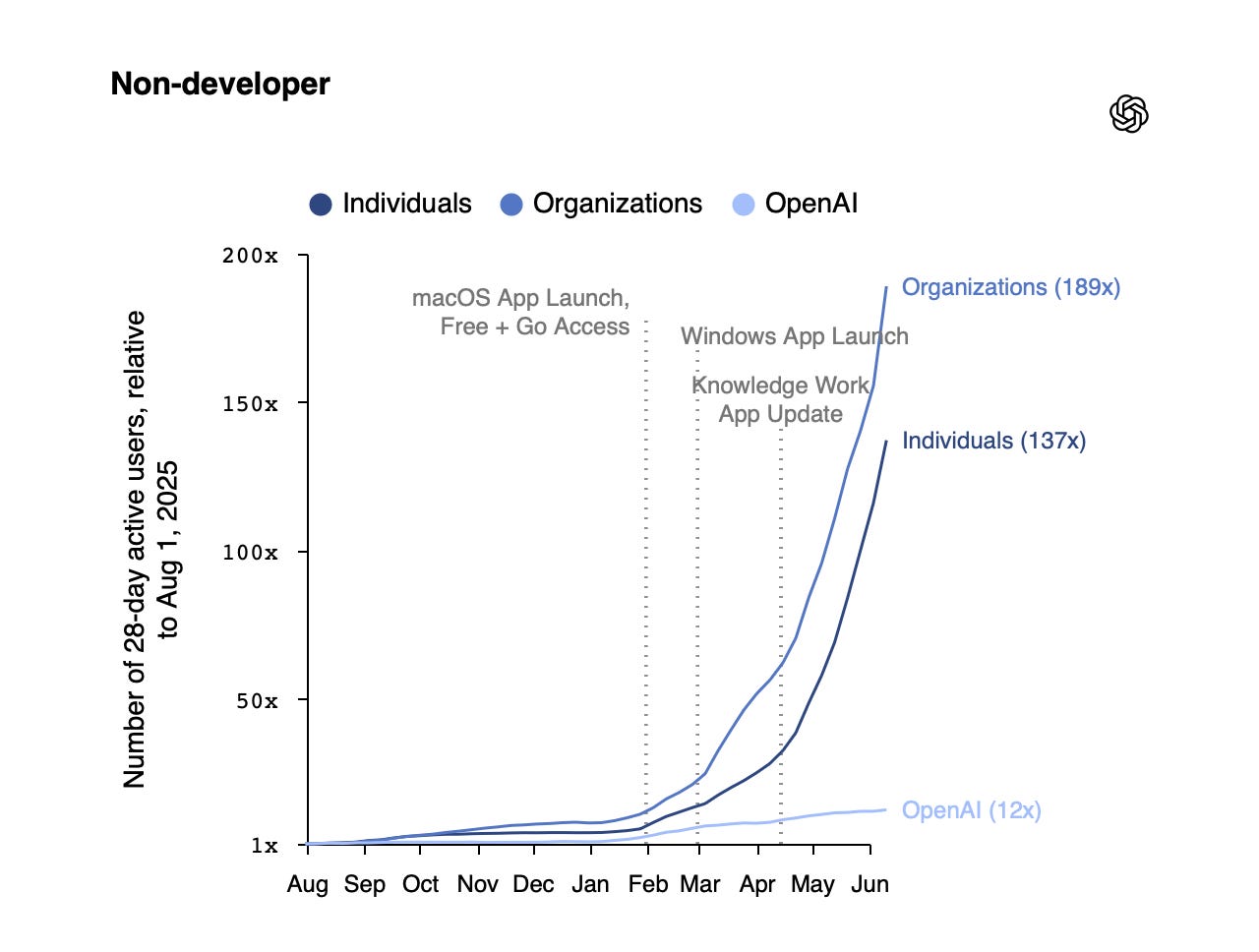
Together they tell the story: agentic applications like Codex start primarily as tools for developers and software engineers, but over time, non-technical professionals start to see their value, dip their toes in, get more comfortable, and eventually end up using them for tasks every bit as sophisticated as those in engineering. This pattern in OpenAI has so completely run its course that nearly all employees in all departments are using Codex, and while Codex use outside of OpenAI is much lower in non-engineering roles, its use is quickly expanding.
This tracks in our own organization. While only a portion of our team uses Claude Code, that group is growing. Those in that set use it all the time, rarely turning to Claude on the web or Claude Cowork. We expect that sometime soon we will look a lot more like OpenAI, with nearly all our people using Claude Code rather than Cowork or Claude.ai.
We’ve written before that we expected this progression, and now OpenAI has the data to prove it. True, some will never fully embrace this technology, either in its simplified forms or its more agentic forms. For everyone else, it’s probably just a matter of time, familiarity, and not unimportantly, the ease of use of the tool. Codex and Claude Code in the Claude Desktop app are visually and technically less intimidating than running Claude Code in a terminal window on your computer. These interfaces will only get more user-friendly. You can expect that you, and those across your organization, will eventually be using generative AI in far more agentic applications than you are today. It matters because these tools are capable of far more sophisticated work than that done by most users today. What’s happened inside OpenAI is going to happen for us all, sooner or later.
Why AI Tells Matter
It’s not why you think.
People are noticing AI tells. We’ve written about the written tendencies of AI models and the visual tells of Claude in just the last few weeks. The New Yorker recently ran a piece on the A.I.-design aesthetic taking over the internet. And we’re learning that the more people see AI writing, the better they get at spotting it. Anecdotally, clients tell us AI slop is showing up from every corner of their organizations. All of it leads to the same question: How do we avoid AI tells in our work?
We think that question misses the point.
The goal isn’t to avoid AI tells. It’s to produce work that’s helpful, fit for purpose, and good enough that you’d put your name on it. (Yes, we just used the construction we’re about to criticize. Stay with us.) Running ctrl+F and swapping out every “moves” won’t change the rigor of a piece if you still handed the model the decisions that mattered. The tell, in isolation, was never the problem.
The “not X, but Y” construction was a standby in JFK’s speeches. “We choose to go to the moon in this decade and do the other things, not because they are easy, but because they are hard.” One of the most iconic lines in speechwriting would sound trite if spoken today, because it now signals autopilot rather than intention. The construction didn’t change. It got overused.
An abundance of tells reveals how the thing got made. One em dash is nothing. A load-bearing metaphor here, a tidy rule of three there, none of them damning on their own. Stacked together, consistently, they signal that you outsourced the decisions. This is the part ctrl+F can’t solve. Find-and-replace changes the surface. It doesn’t change the fact that you let the model do the thinking. The reader who clocks the pattern isn’t reacting to the em dash. They’re reacting to what the em dash, plus everything around it, says about the effort behind it.
The New Yorker piece put it well, quoting designer Matt Ström-Awn, who called Claude’s default design choices a mark of complacency, “a filtering mechanism” that exposes “people who didn’t spend the time.” The problem isn’t that Claude’s designs are inherently bad. The problem is they are evidence of delegated decisions.
So we shouldn’t hide tells to hide AI use. When we notice one, whether it’s a load-bearing metaphor or a white card with a thin colored line, the question isn’t how to get rid of it. It’s whether this is really the best way to convey the idea, in words or visually. Does it reflect our perspective? Does it do the job we need it to do? Did we make enough of the decisions that we can stand behind the result?
Sometimes the answer is that the em dash stays, or the AI-produced visual does exactly what it needs to. That’s fine. The point was never purity. The point is that it’s a choice we made, and we know we made it.
Watch and Learn
What tacit knowledge can teach us about our own expertise.
Dutch startup Monumental builds robots that lay bricks. Its engineers interviewed master masons about how to build a good wall, but, to their surprise, learned very little that they could teach the robots. “That’s the way I’ve always done it,” the bricklayers said, again and again. The engineers turned instead to video footage, hoping the masons would show what they could not tell. Indeed, on video the master masons vibrated their hands slightly as they set each brick, working mortar into the pores for a stronger bond. None of them had mentioned it because none of them knew they did it.
Last week, The Economist used this story to illustrate a problem organizations face when it comes to generative AI. “Tacit knowledge,” or know-how born of experience that resists being written down, is vital to most jobs and difficult to codify. The piece walks through the methods some companies are trying, from ingesting enterprise data to monitoring call-center screens and logging keystrokes. It ended where these efforts tend to end, with Meta employees revolting over a program to track their clicks, and with a set of uncomfortable questions about surveillance and who owns know-how once it has been captured.
Tacit knowledge, then, at the organizational level, is a dilemma to be wrestled with. At the individual level, there is a quieter version happening. The tacit knowledge that’s so difficult to extract at scale is much more readily surfaced upon individual or small-team interrogation. The worker who can articulate the equivalent of the masons’ hand vibration is not the one most easily replaced. Rather, they are the better craftsman, the better teacher, the one whose expertise compounds rather than disappears with AI augmentation.
This gets at the real skill in using AI well, and it has almost nothing to do with prompting technique or “use cases.” The gap between people who are pretty good with these tools and people who are skillful with them comes down to how clearly they have examined their own work. Many users delegate to AI from a vague sense of what they want, and get vague results back. We argue that users should instead do the harder thing first: define what good looks like when an expert human completes the task at hand, in terms specific enough to hand off. Examples might include a detailed style guide, or a complex skill or project. Breaking a task down into its component tasks is the exercise worth spending time on. Considering the step-by-step process of getting from beginning to end is where the value lies.
In doing this, you’ll likely discover just how few of your rules are actually rules. Sitting down to catalogue a style guide or a set of project instructions, we often find a labyrinth of conditions just beneath the surface. “Do this, unless the audience is that, in which case lean the other way, but watch for the case where it reads as something you never intended…” What looked like one clean rule was a vast network of if-then judgments, made by the expert on instinct. A well-crafted skill or project can cover the top layer of this network (and do it well!) but it will never hold all of it.
This is how capturing tacit knowledge protects expertise rather than erasing it. You document the part that can be documented, thereby throwing into relief the part that cannot; the contingent, context-soaked judgment about which rule applies when. The judgment continues to be the difference-maker. It sits behind a wall that even the most complete style guide does not breach, because by the time a decision reaches it the rules have run out and something more like gut takes over. The Economist piece closes by asking whether machines learning more and more will erode how people acquire and pass on expertise. The route through self-examination suggests the opposite is available to anyone willing to take it. Studying your own craft closely enough to teach it to a machine is how you come to understand it better yourself.
The Shifting Value of Human Expertise
Traditional markers of expertise may be less important with AI.
New labor-market data from researchers at UCLA suggests that some traditional markers of a worker’s knowledge and experience—of “human capital”—have steadily lost value in AI-exposed professions since ChatGPT’s release in late 2022. The study’s findings are early and limited to freelance work, but what it indicates about the changing perceptions of certain kinds of expertise and labor is worth noting.
The study drew on nearly 50,000 profiles from Upwork, a large freelance hiring platform, covering some 2.3 million contracts between January 2021 and March 2026. The researchers focused on the most AI-exposed work. Translation and interpretation services ranked highest, followed by creative writing, web research, public relations, and customer service. They sorted each worker’s profile into four categories: chosen job title and description, accumulated credentials like education and experience, platform ratings and reviews, and posted hourly rate. When hiring for these roles, the importance of the first three signals (each a marker of human skill and expertise) fell by roughly 7.8%, while the importance of price rose by about 1.1%. Employers, in short, are increasingly looking for cheap work over expert work in AI-exposed professions.
The authors read this as the result of a growing belief amongst employers that AI standardizes worker output, making them less willing to pay a premium for expertise and more inclined toward cheaper, less credentialed alternatives. That tracks with the early research on the jagged frontier: AI improves low- and mid-level professionals’ performance more drastically than it does for top-tier professionals, creating a much larger pool of average work and workers. We would expect that effect to surface first for work that AI has long done well, like translation, and to increase as adoption widens.
But we would caution against reading this as general proof that AI makes all expertise matter less, or that hiring truly excellent people no longer pays off. If anything, we’re finding that AI puts expertise at an even greater premium, because it’s often all that lifts a professional and their work above the ever-expanding, self-cannibalizing average. We’d expect that those organizations with the wisdom to see past the near-term pull toward cheaper, “good enough” talent will benefit over the long run.
The study does leave us with a few interesting open questions that we’ll be watching out for moving forward. The authors argue that price is increasing in importance in part because it’s the dimension that “still differentiates workers” when AI homogenizes outputs. We wonder whether hiring managers will hold that view as AI integration deepens inside their own organizations, and, as we wrote last week, the cost of AI models and tools themselves becomes a bigger factor. Increasingly, AI “expertise” is also expensive, and for some things it may not always be worth the price tag. We also would not be surprised to see changes in how candidates articulate or prioritize their skills. What this study shows most convincingly is that certain traditional signals of candidate value—like a college education or hyper-specialized expertise—may carry less weight than they once did. So we’re not counting human expertise out just yet. But we will keep watching how the kinds of expertise that matter, and the ways professionals signal that value, continue to evolve.
We’ll leave you with something cool: Teddy Warner built a wall display that shows AI-generated illustrations of different bird species heard outside his apartment.
AI Disclosure: We used generative AI in creating imagery for this post. We also used it selectively as a creator and summarizer of content and as an editor and proofreader.