
Confluence for 7.19.26
An illustration of how things have changed. The increasingly capable "practical frontier." How language influences a model's values. Disclosure takes the floor.
Welcome to Confluence. Here’s what has our attention this week at the intersection of generative AI, leadership, and corporate communication:
An Illustration of How Things Have Changed
The Increasingly Capable “Practical Frontier”
How Language Influences a Model’s Values
Disclosure Takes the Floor
An Illustration of How Things Have Changed
Sometimes you need a look back to see how far you’ve come.
We thought about a task this week that we’ve seen many times.
Over the last 30 years, our communication advisory practice has on many occasions helped employees and stakeholders understand an enterprise resource planning system, or “ERP.” ERPs are relatively complicated integrations of data and software that allow different parts of an organization’s business to coordinate and share data with each other. Oracle and SAP are examples.
ERPs are technical, complex, and difficult to explain. Without fail, at some point in the process of deploying one, someone tries to use PowerPoint to create an illustration to help people understand ERP and how it works. That’s hard to do, so usually someone then hires an information designer, and the result is a beautiful poster or slide that shows all the stakeholders’ requirements, data, and interactions between the systems (done at a relatively significant time and expense).
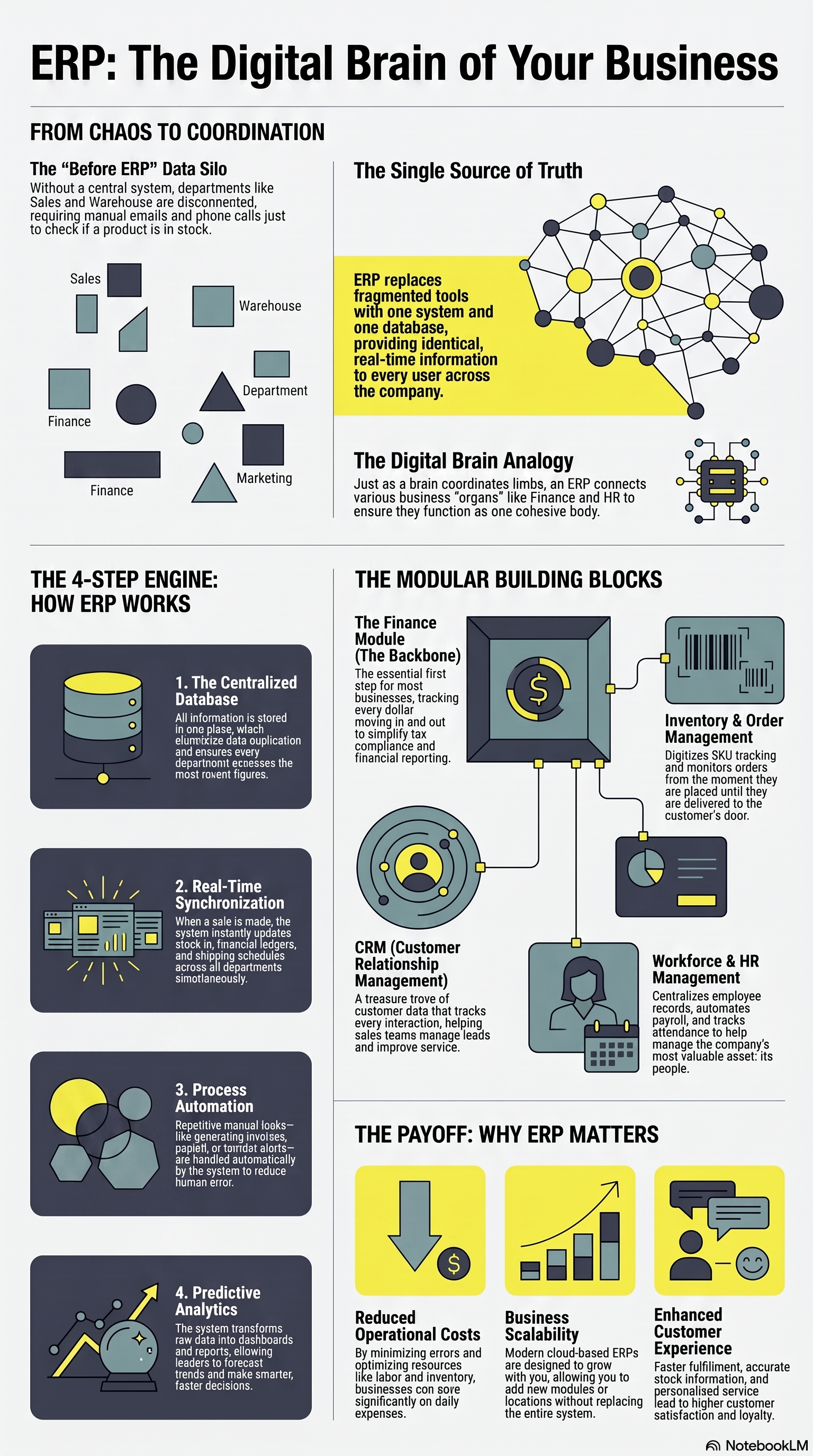
Now let’s consider how things have changed. Today, one can simply go to Google’s NotebookLM and say to it, “Research ERP so I can create an infographic that explains it for non-technical laypeople.” After it spends two or three minutes pulling in resources, one can have it create the following infographic with one click and about two minutes of time invested:
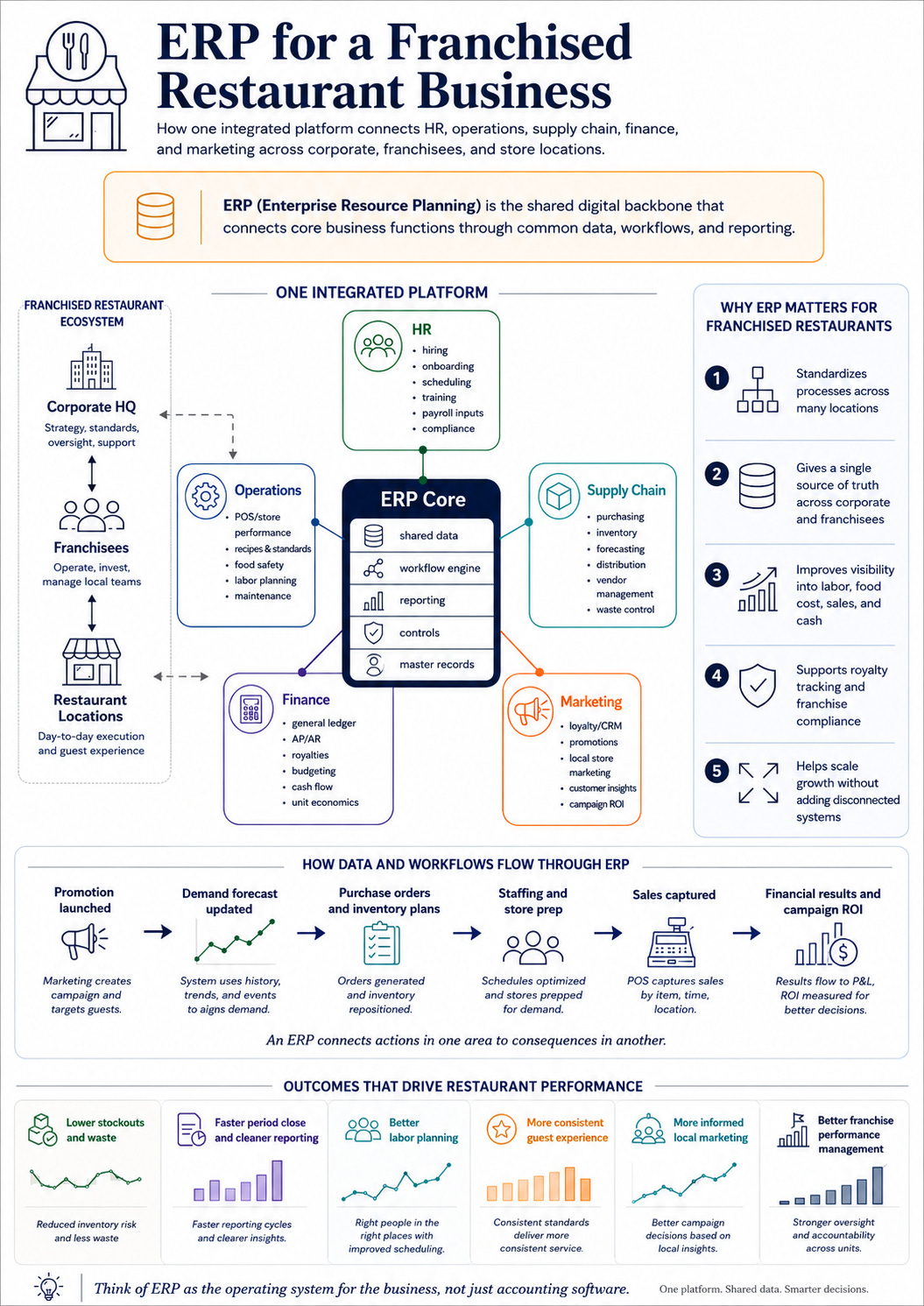
Or one can go to ChatGPT 5.6 Sol and say, “Do research on ERP and then use your image generator to create an infographic that explains it for people in a franchised restaurant business. Presume HR, operations, supply chain, finance, and marketing systems. Use a high-end visual style informed by the thinking of Ed Tufte.” And in three minutes, you have this:
Or one can go back to NotebookLM and use its video-creation tool with this prompt: “Create a video that explains ERP, what it is, and how it works for non-technical laypeople. It should pay particular focus on the integration of data and the ultimate payoff for the business and its employees. Use a high-end professional graphical style that one would expect to see in an explainer for sophisticated professionals.” And 10 minutes later, we have this:
Each of these explainers is technically accurate, but also generic and imperfect for a specific audience or use. They also come from simple prompts with very little context explaining audience, style, parts of the story to emphasize or downplay, etc. They are out-of-the-box products. But what is impressive is the quality and the fact that your author was able to create them all with nothing more than a paid subscription to a leading large language model. On its face it seems a simple thing, but at a deeper level it represents a pretty radical shift in content production from technically trained experts (in this case information and video designers) to laypeople.
We’ve seen things like this before. The evolution of blogging made everyone a publisher. The evolution of Instagram made everyone a photographer. Will large language models make everyone a designer? Since these outputs simply reflect pattern recognition conducted by the large language model, can we expect to see a similar shift among other patterns, like legal contracts or real estate listings or any other manner of technical expertise?
We think probably so, and our small ERP illustration test is an object lesson in the redistribution of content expertise from technical experts to laypeople. And yes: these illustrations don’t reflect the best design or the best taste or perhaps the best decisions or the gestalt or anything else that a designer with deep expertise would bring to the task. But the fact is, the large majority of technical tasks don’t require the third standard deviation of expertise or gestalt or taste. Most contracts are standard. Most stock photography is stock. Most consulting advice is well-established. We think leaders need to prepare themselves for the fact that, both in the domain where they have expertise and in domains where they need it, we’re moving into a world where that expertise is distributed far more evenly across people than ever before.
While we talk about the pace of LLM change often in this space, stumbling across this old “create an ERP explainer” task this week illustrated for us how far things have come in such a short period of time. It seems a notable milestone along the journey we’re taking toward some form of highly capable, and widely available, general intelligence.
The Increasingly Capable “Practical Frontier”
A reminder that today’s ceiling is tomorrow’s floor.
As we’ve documented here, Claude Fable 5 — one of the most capable publicly accessible models in the world — spent its first six weeks moving in and out of reach. After the model’s release in early June, a federal export control took it offline for nearly three weeks. It returned on July 1 with a deadline attached: the model would be available as part of standard plans for an initial period, and would then shift to a usage-based pricing model. That deadline was extended several times. On Friday, Anthropic appeared to settle the question for now, announcing that it will include Fable in top-tier plans (technically, Max and Team Premium plans) and make it available via usage credits in standard plans. We’ll see if that holds, but in the past six weeks, one of the most capable models we’ve had access to has been, by turns, banned, restored, rationed, and repriced.
It’s worth understanding why. Setting the regulatory aspect aside, the biggest driver behind the repeated extensions was competitive pressure. On July 9, OpenAI made GPT-5.6 generally available, with its flagship Sol tier coming in at roughly half the price of Fable. Within days of that model’s release, it was available to millions of users in Microsoft Copilot. A few days later, Chinese lab Moonshot released Kimi K3, an open-source model that early benchmarks place just behind Fable 5 and Sol at roughly a quarter of the cost. The competition is as intense as ever and — at least for now — individual and organizational consumers stand to benefit.
This is part of a broader pattern that’s been playing out for nearly four years. While we often talk about the frontier of generative AI capabilities, there are really two frontiers. The true frontier — the bleeding edge of capabilities — will be increasingly precarious. As we’ve seen with the rollout of Fable and GPT-5.6, new frontier models will likely be subject to government review, which may delay or even prevent general access (as has been the case with Anthropic’s most powerful model, Mythos). And, as we’ve written about here and here, the models at the true frontier may be cost-prohibitive for many individuals and organizations.
There’s also the “practical frontier,” the more durable, broadly accessible set of models and capabilities for everyday users and everyday use. That practical frontier is improving at roughly the same rate as the “true” frontier. Today’s practical frontier is yesterday’s true frontier, and we see no reason for that pattern not to hold.
Viewed from this perspective, access to Fable 5-class capabilities is likely a short-term concern. Fable 5 has crossed a threshold of capabilities: sustained reasoning over enormous amounts of context, long-horizon work completed with minimal supervision, and what it looks like when an AI just “gets it” enough to do real, complex work. If that capability is out of reach or unaffordable at scale for your organization today, it likely won’t be for long. If the pattern holds, and we expect it will, something like it will sit within the practical frontier within months, embedded in the everyday tools people already use, at prices manageable enough for broad deployment.
The teams that will be best positioned for what’s coming will plan now for a future where Fable-class capability is standard. That begins with building fluency with what the practical frontier already offers (which, as we wrote last week, most of us have yet to fully explore). But it also means paying close attention to the true frontier, even when its models sit behind a government review, a premium price, or a restricted tier. What happens at the true frontier is the best preview of what everyone will have access to a few months later. Today’s ceiling is tomorrow’s floor, and both are rising fast.
How Language Influences a Model’s Values
Russian Claude is distinct from Hindi Claude.
Anthropic published new research examining how the values Claude expresses shift depending on the language of the conversation. The team analyzed roughly 310,000 conversations with Claude involving subjective tasks, labeling each for the presence of 339 high-level values, then compressed those values into a small number of interpretable dimensions. To check that the method was measuring something real, they first compared value profiles across three Claude models. The profiles matched Anthropic’s own data on how users perceive their models (Sonnet 4.6 as warm and encouraging, Opus 4.7 as rigorous and cautious), validating their approach.
The analysis surfaced four dimensions where Claude’s expressed values vary most: Deference vs. Caution (accommodating the user vs. guarding against risk), Warmth vs. Rigor (positivity and care vs. accuracy and precision), Depth vs. Brevity (explaining thoroughly vs. doing only what was asked), and Candor vs. Execution (foregrounding uncertainty vs. delivering a polished, confident answer). When Anthropic compared these profiles across the 20 most common languages on the platform, the contrasts were real and meaningful. Claude leans furthest toward warmth in Hindi and Arabic and furthest toward rigor in English and Russian. It expresses the most caution and depth in English and the most deference and brevity in Arabic. As the researchers note, two people asking for feedback on the same business plan, one in Hindi and one in Russian, may come away with different impressions of its quality.
To be clear, language doesn’t fundamentally change Claude’s character. Most of the 339 values Anthropic tracked barely move at all, and even where the shifts happen, they are small relative to the variation from one conversation to the next. Claude in Hindi is still Claude. But the leans are structured, detectable, and consistent enough to shape what users experience over time, which is what makes them worth understanding. And none of this should surprise us. The text represented in a model’s training data differs from language to language, so the model is learning from different patterns depending on the language, and the values embedded in those patterns are likely to differ too.
The lesson for leaders is awareness. Models carry biases and tendencies, as all people do, and knowing them is the first step to managing them and working against them when needed. These tendencies shift not only by language but by model. Each model carries its own distinct qualities, and the labs training them are still deciding which values models should express and how to express them effectively. Attentiveness from the user remains the key.
Disclosure Takes the Floor
What a labeling mandate might indicate about the appetite for governance.
Late last month, Senators Brian Schatz, John Curtis, and Mark Warner introduced the AI Labeling Act of 2026, which would require providers of generative AI systems to attach a visible disclosure to AI-generated content, along with a machine-readable disclosure recording the system used and the time it was created. The requirement would extend to imagery, videos, audio, and chatbot interactions. Large platforms, defined as those with at least 10 million monthly U.S. users or more than $1.5 billion in annual revenue, would have to flag the AI-generated content and would be barred from stripping the disclosures out. If it becomes law, it would be enforced by the FTC, and NIST would convene a working group to set the technical standards.
We’re more interested in what the bill’s introduction signals about the mood of the moment than in its merits. The content-labeling measure is bipartisan, backed by SAG-AFTRA, the Authors Guild, and the Songwriters Guild, and based on a simple belief: people deserve to know when content is AI-generated. We buy that.
That it reached the Senate floor at all — with backing across the aisle and from the creative industries — tells us something about where the public is. Disclosure was a question for ethics panels and comms-team footnotes two years ago. Now it has a marquee. The demand for provenance is running ahead of the means to deliver it, and that gap is worth noticing.
Down the road, were this bill to be enacted, the disclosure question would shift from “Should I disclose this?” to “How do we manage disclosure throughout the process of editing, centaur-like collaboration, and human judgment?” especially if audiences begin to expect disclosures more regularly. We’re not there yet, but this bill’s introduction caught our attention. We’ll be following the story with interest, though our advice holds: the organizations best positioned for whatever the future holds are the ones that can already show how their work gets made.
We’ll leave you with something cool: Ethan Mollick had Fable create a consulting-style pitch deck for Odysseus, trying to convince him to stay in Troy.
AI Disclosure: We used generative AI in creating imagery for this post. We also used it selectively as a creator and summarizer of content and as an editor and proofreader.
Hi... just a thought for you to consider; your CRA prefix means something, whatever it is, to you, and is important. You might not know that to Canadians, CRA has a powerful trigger reflex, because we know it as 'Canada Revenue Agency' ... the equivalent of America's IRS ... so ... just saying, most Canadians will perceive what you are publishing as their government messaging them. It's not logical; it's just real and negative